
Goodluck Defence & Aerospace: Is India's Defence Manufacturing Boom Creating a Long-Term Investment Opportunity?
Introduction: India's Defence Manufacturing Industry Is Evolving
India's defence sector is undergoing a significant transformation. The government's focus on domestic manufacturing, defence modernisation, export development, and reduced dependence on imported equipment is creating opportunities for Indian manufacturers.
Within this changing landscape, **Goodluck Defence & Aerospace** is presented as a potential beneficiary of India's expanding defence manufacturing ecosystem.
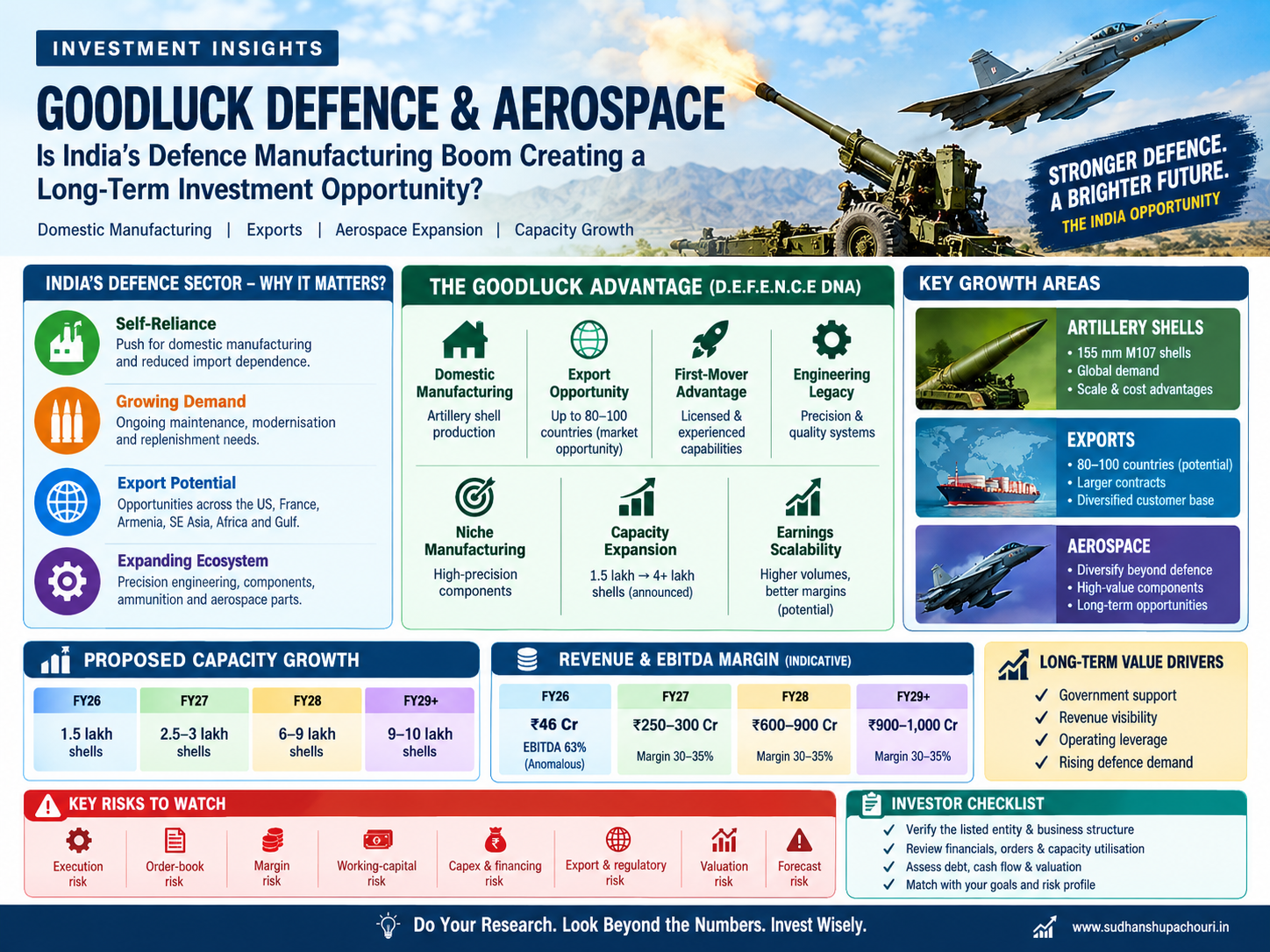
The investment infographic highlights an opportunity built around artillery shell manufacturing, production capacity expansion, exports, and diversification into aerospace components. It also presents a potential growth trajectory that investors may find worth investigating.
However, an important distinction must be made: a promising industry outlook does not automatically translate into attractive shareholder returns. Investors need to evaluate the company's actual financial performance, order book, production capabilities, profitability, valuation, and execution risks before making an investment decision.
Let's examine the opportunity in detail.
1. Why Is India's Defence Manufacturing Sector Attracting Attention?
India's defence manufacturing industry is supported by several structural factors.
A. Greater emphasis on domestic manufacturing
India's push towards self-reliance in defence creates opportunities for domestic manufacturers capable of supplying quality products at competitive prices.
Domestic manufacturing can help strengthen supply chains, improve production capabilities, and reduce dependence on foreign suppliers.
For companies that possess the necessary licences, technical capabilities, manufacturing infrastructure, and customer relationships, this environment may create opportunities for business expansion.
B. Growing defence production requirements
Defence equipment requires ongoing maintenance, replacement, modernisation, and replenishment.
Ammunition and other consumable defence products can have different demand characteristics from large, long-life equipment platforms. Their demand depends on procurement programmes, inventory requirements, operational needs, and government purchasing decisions.
Manufacturers that can meet stringent quality standards and delivery schedules may be positioned to participate in these opportunities.
C. Export opportunities
Indian defence manufacturers may also benefit from international demand.
The infographic identifies export markets across regions including the United States, France, Armenia, Southeast Asia, Africa, and the Gulf.
However, the ability to serve these markets depends on applicable export authorisations, customer approvals, product certifications, contractual arrangements, and geopolitical considerations.
Export potential should therefore be distinguished from confirmed export orders.
D. Development of a broader manufacturing ecosystem
Defence manufacturing extends beyond finished equipment.
It can involve precision engineering, fabricated components, specialised materials, ammunition, mechanical systems, and aerospace parts.
Companies that successfully develop additional capabilities may be able to diversify their revenue sources and reduce dependence on a single product category.
2. Understanding the Goodluck Defence & Aerospace Opportunity
The infographic presents Goodluck's defence and aerospace opportunity through a framework described as the “D.E.F.E.N.C.E DNA.”
The framework highlights seven business themes.
Domestic Manufacturing
Domestic manufacturing is central to India's self-reliance ambitions.
For Goodluck, the infographic positions artillery shell manufacturing as an important part of its defence opportunity.
The investment case depends on the company's ability to convert manufacturing capabilities into commercial orders, execute contracts efficiently, and maintain the required product quality.
Export Opportunity
The infographic identifies international markets as a potential source of future growth.
Exports could provide access to a broader customer base and potentially reduce dependence on domestic procurement cycles.
Investors should nevertheless examine actual export revenue, the geographical distribution of customers, the repeatability of orders, and the company's exposure to regulatory restrictions.
First-Mover Advantage
The infographic highlights the company's existing industrial experience and licensed artillery production capabilities.
In specialised manufacturing, experience, customer qualifications, production processes, and regulatory approvals can create barriers to entry.
However, a genuine first-mover advantage must be demonstrated through measurable competitive strengths, such as established customer relationships, cost efficiency, reliable delivery, product quality, and sustained market share.
Engineering Legacy
An established engineering background can provide a foundation for entering specialised manufacturing categories.
Relevant capabilities may include precision fabrication, process control, quality assurance, production engineering, and industrial-scale operations.
Investors should evaluate how effectively these capabilities translate into the company's defence and aerospace operations.
Niche Manufacturing
Specialised manufacturing may offer opportunities to serve markets that require technical expertise and regulatory compliance.
The infographic emphasises high-precision components as part of the broader opportunity.
A niche business can be attractive when it has strong customer relationships, reasonable pricing power, reliable demand, and sustainable margins.
Capacity Expansion
The infographic presents a planned increase in artillery shell manufacturing capacity from approximately 1.5 lakh shells to more than 4 lakh shells.
If successfully implemented and supported by demand, higher capacity could allow the company to fulfil larger orders.
However, installed capacity alone does not generate revenue. Actual production, utilisation, customer acceptance, deliveries, and collections determine the financial outcome.
### Earnings Scalability
Higher production volumes can improve profitability when fixed costs are spread across a larger output.
This is known as operating leverage.
However, operating leverage works in both directions. Lower-than-expected demand, underutilised facilities, rising input costs, or delays in production can adversely affect margins.
For this reason, investors should focus on sustainable operating profitability rather than capacity expansion alone.
## 3. Artillery Shell Manufacturing: The Core Opportunity
The infographic identifies 155 mm M107 artillery shells as a key part of the manufacturing opportunity.
It highlights the following potential advantages:
- Established demand for widely used ammunition types.
- Opportunities to expand production capacity.
- Potential access to international markets.
- Opportunities to manufacture guided and other ammunition variants, subject to the relevant technical and regulatory requirements.
- Scope for economies of scale as production increases.
### Why production scale matters
Manufacturing scale can influence a company's competitiveness.
A larger production base may help improve procurement efficiency, manufacturing utilisation, and fixed-cost absorption.
Nevertheless, the benefits depend on the economics of individual contracts. Large orders can produce disappointing returns if pricing is aggressive, input costs rise unexpectedly, or working-capital requirements become excessive.
Investors should examine the following indicators:
1. Actual annual production and deliveries.
2. Confirmed order book and contract duration.
3. Average selling prices and production costs.
4. Capacity utilisation.
5. Receivables and customer payment cycles.
6. Capital expenditure required for expansion.
7. Regulatory and quality-compliance requirements.
These indicators provide a more reliable basis for evaluating the business than headline production capacity alone.
## 4. Export Potential: An Additional Growth Driver
International demand could become an important contributor to a defence manufacturer's long-term growth.
The infographic refers to exports to 80–100 countries as part of its export opportunity discussion.
This figure should be treated as a market opportunity highlighted in the infographic, not as confirmation that Goodluck currently exports to that many countries.
### How exports could support growth
A successful export business can offer several benefits:
**Broader customer reach:** International sales can expand the company's addressable market.
**Potential for larger contracts:** Overseas procurement programmes may create opportunities for manufacturers that meet the relevant requirements.
**Customer diversification:** A broader customer base can reduce dependence on a limited number of buyers, although concentration can remain high even in an export-oriented business.
**Long-term relationships:** Repeat contracts may improve demand visibility and production planning.
### What investors should verify
Before relying on export growth in an investment thesis, investors should examine:
- Actual export revenue and its share of total sales.
- Confirmed international orders.
- Customer and country concentration.
- Export licences and other regulatory approvals.
- Contract margins and payment terms.
- Foreign-exchange exposure.
- The risk of contract delays or cancellations.
An expanding addressable market is encouraging, but realised revenue and cash flow are what ultimately matter to shareholders.
## 5. Aerospace Expansion: Diversification Beyond Defence
Another important theme in the infographic is expansion into aerospace components.
Aerospace manufacturing can involve demanding technical requirements, specialised materials, precision engineering, stringent quality controls, and lengthy customer qualification processes.
For a company with relevant engineering and manufacturing capabilities, this market may provide an opportunity to diversify its business.
### Potential benefits of aerospace diversification
**Additional revenue streams:** Aerospace components could contribute revenue beyond traditional defence manufacturing.
**Broader customer relationships:** Serving additional industrial customers may diversify the business.
**Higher-value manufacturing opportunities:** Certain specialised components may command attractive margins when supported by technical capabilities and customer qualifications.
**Long-term development opportunities:** Successful entry into new manufacturing categories can create opportunities for further capability development.
However, aerospace diversification should not automatically be interpreted as an immediate earnings driver.
Investors should establish whether aerospace sales are already contributing meaningfully to revenue or whether the business remains in an investment and development phase.
The relevant indicators include confirmed customer programmes, qualification status, capital expenditure, commercial production timelines, and segment profitability.
## 6. Capacity Expansion and the Company's Growth Trajectory
One of the most striking features of the infographic is the proposed increase in production capacity.
It presents the following figures:
| Financial year | Production capacity indicated in the infographic |
| FY26 | 1.5 lakh shells |
| FY27 | 2.5–3 lakh shells |
| FY28 | 6–9 lakh shells |
| FY29 onward | 9–10 lakh shells |
**Important clarification:** These figures are reproduced from the supplied infographic. They have not been independently verified and should not be interpreted as confirmed production, sales, or achieved capacity.
The infographic also presents a separate scale-up statement referring to growth from 1.5 lakh shells to more than 4 lakh shells. The relationship between that statement and the larger capacity figures requires clarification from official company disclosures.
### Why investors should distinguish capacity from production
There are several different stages between an expansion plan and financial success:
1. **Planned capacity:** The company announces a production target.
2. **Installed capacity:** The necessary facilities and equipment are established.
3. **Operational readiness:** The facility can produce commercially acceptable products.
4. **Capacity utilisation:** Production reaches a meaningful proportion of available capacity.
5. **Customer deliveries:** Manufactured products are delivered under contracts.
6. **Revenue recognition:** The relevant accounting conditions for recognising sales are met.
7. **Cash collection:** Customers pay the company.
A company can make progress at one stage without having completed the others.
Consequently, investors should monitor actual production and deliveries alongside capacity announcements.
## 7. Revenue Growth and Profit Margins: What Do the Projections Mean?
The infographic presents the following revenue trajectory:
| Financial year | Revenue indicated in the infographic |
|---|---:|
| FY26 | ₹46 crore |
| FY27 | ₹250–300 crore |
| FY28 | ₹600–900 crore |
| FY29 onward | ₹900–1,000 crore |
It also shows an EBITDA margin of approximately 63% for FY26, labelled anomalous, followed by a projected margin of 30–35% from FY27 onwards.
These figures are infographic estimates, not independently verified financial results or guaranteed future performance.
### Why revenue growth alone is not enough
Revenue measures business activity, but it does not tell investors how much profit the company generates or how much cash it retains.
A business experiencing rapid expansion may also face higher expenses, increased working-capital requirements, additional borrowing, and substantial capital expenditure.
A proper analysis should therefore examine revenue growth alongside:
- Gross profit margins.
- EBITDA and operating margins.
- Net profit after tax.
- Operating cash flow.
- Capital expenditure.
- Borrowings and interest expenses.
- Return on capital employed.
- Receivables and inventory levels.
### Understanding EBITDA margins
EBITDA stands for earnings before interest, taxes, depreciation, and amortisation.
The EBITDA margin measures EBITDA as a percentage of revenue.
For example, if a business generates ₹100 crore in revenue and earns ₹30 crore in EBITDA, its EBITDA margin is 30%.
A higher margin can indicate stronger operating profitability, but EBITDA is not the same as net profit or free cash flow.
Capital-intensive manufacturing businesses may incur significant depreciation, financing costs, and expansion-related expenses. These must also be considered.
The unusually high FY26 margin shown in the infographic is specifically labelled anomalous. Investors should not extrapolate it without understanding the underlying calculation and the company's reported financial statements.
## 8. What Could Drive Long-Term Value Creation?
The infographic presents a value-creation framework based on four broad drivers.
### Government support
Policies encouraging domestic manufacturing and self-reliance can support the development of India's defence industrial base.
The commercial impact on an individual company, however, depends on its eligibility, contracts, execution capabilities, and competitive position.
### Revenue visibility
A strong order book can provide better visibility into future business activity.
But the quality of an order book matters as much as its size. Investors should consider delivery schedules, cancellation provisions, contract profitability, customer concentration, and payment terms.
### Operating leverage
Increasing production can improve margins when revenue grows faster than operating costs.
The opposite can occur if demand weakens or new facilities remain underutilised.
### Demand for weapons systems
Defence procurement and replenishment requirements can create demand for ammunition and related manufacturing services.
Nevertheless, procurement is influenced by budgets, policy decisions, international relations, inventory levels, and contract timing.
A sustainable investment thesis should account for both the opportunities and the cyclical nature of defence procurement.
## 9. What Makes Goodluck Different From a Typical Manufacturer?
The infographic compares Goodluck's positioning with that of a typical manufacturer.
It emphasises several potential differentiators:
- Licensed artillery production.
- Capacity expansion plans.
- An established engineering background.
- Export opportunities.
- Aerospace diversification.
- Potential for multi-year business growth.
These characteristics could be meaningful if supported by verifiable operating and financial evidence.
However, the comparison should not be treated as proof that the company is superior to every competing manufacturer.
A meaningful competitive assessment requires comparison with relevant listed peers on factors such as:
1. Revenue growth and profitability.
2. Order-book strength.
3. Production capacity and utilisation.
4. Customer concentration.
5. Debt and cash flow.
6. Return on capital.
7. Valuation relative to earnings and growth prospects.
8. Execution history.
A differentiated business model can create value, but only if the company can execute its strategy profitably.
## 10. Shareholding Structure and Promoter Confidence
The infographic includes a shareholding snapshot showing 80% attributed to Goodluck India Limited and 20% to public and other shareholders.
This ownership split has not been independently verified and should not be assumed to represent the current shareholding structure of a separately listed investment opportunity.
Before investing, readers should identify the exact legal entity associated with the defence business and determine whether the opportunity is available through a listed company's shares or another investment structure.
If the business is a division or subsidiary of another company, the relationship between the operating business and the listed entity is especially important.
Investors should verify:
- The legal entity operating the defence business.
- The current shareholding structure.
- Whether the business is separately listed.
- The financial contribution of the defence division to the parent company.
- Related-party transactions, where relevant.
- Corporate announcements and disclosures.
A strong promoter background can be useful, but it is not a substitute for sound financial performance, transparent governance, and a reasonable purchase price.
## 11. Who Might Find This Investment Theme Interesting?
The infographic identifies three broad investor categories.
### Long-term investors
Investors interested in India's defence manufacturing and aerospace development may wish to study companies operating in these industries.
Their analysis should focus on the sustainability of earnings, the quality of the business, and the price paid for future growth.
### Opportunity seekers
Investors looking for emerging defence manufacturers may investigate businesses with new production capabilities, expanding customer relationships, or potential entry into additional markets.
However, emerging opportunities can involve considerable uncertainty, particularly when projected growth is much faster than the company's established operating scale.
### High-conviction investors
Investors who have conducted detailed research may be willing to accept business-specific risks in pursuit of long-term returns.
Conviction should be based on verifiable evidence rather than promotional material alone.
A concentrated position in a single company can expose an investor to significant company-specific risk. Position sizing and diversification therefore remain important considerations.
## 12. Key Risks Investors Should Not Ignore
No investment opportunity should be evaluated solely on its growth potential.
The following risks deserve careful consideration.
### Execution risk
Planned facilities may be delayed, production targets may not be achieved, and customer deliveries may take longer than expected.
### Order-book risk
Expected demand may not translate into confirmed contracts. Existing orders may also be delayed or cancelled, depending on their terms.
### Margin risk
Higher input costs, pricing pressure, inefficient operations, and changes in product mix may reduce profitability.
### Working-capital risk
Manufacturing growth can require substantial spending on inventory and receivables before customers pay.
Rapid revenue growth accompanied by weak operating cash flow deserves particular attention.
### Capital expenditure and financing risk
Expanding manufacturing capacity may require significant investment. Borrowing to fund expansion can increase interest expenses and financial risk.
### Export and regulatory risk
Defence exports are subject to legal and regulatory requirements. International restrictions, geopolitical changes, and delays in approvals may affect business opportunities.
### Valuation risk
Even a successful company can generate disappointing investment returns if its shares are purchased at an excessive valuation.
Investors must evaluate the price relative to sustainable earnings, cash flow, growth prospects, and downside risks.
### Forecast risk
The revenue, margin, and capacity figures presented in the infographic may not materialise as expected.
Investment decisions should rely on official disclosures and independently assessed assumptions rather than treating projections as established facts.
## 13. A Practical Checklist Before Investing
Before considering an investment related to Goodluck Defence & Aerospace, investors should work through the following checklist.
**Business verification**
- Identify the exact listed company or investment entity.
- Confirm the relationship between the defence business and its parent company.
- Review the products manufactured and the applicable licences.
**Financial performance**
- Read the latest audited annual report.
- Examine quarterly revenue and profit trends.
- Review EBITDA margins and net profit.
- Compare operating cash flow with reported earnings.
**Growth and execution**
- Verify the latest announced production capacity.
- Check actual capacity utilisation and commercial deliveries.
- Review confirmed orders and customer concentration.
- Examine the status of aerospace expansion.
**Financial strength**
- Review debt and interest coverage.
- Assess working-capital requirements.
- Examine capital expenditure commitments.
- Evaluate return on invested capital.
**Valuation**
- Compare valuation multiples with appropriate peers.
- Consider conservative, base-case, and optimistic business scenarios.
- Assess the downside if growth or margins disappoint.
**Portfolio suitability**
- Determine whether the investment matches your financial goals, time horizon, and risk tolerance.
- Avoid excessive concentration in a single company or sector.
- Consider the role of the investment within the overall portfolio.
This process helps distinguish a compelling industry narrative from an investment that is financially attractive at its current price.
## 14. The Bigger Picture: India's Defence Manufacturing Opportunity
India's ambition to strengthen its domestic defence industry may create opportunities for manufacturers that can combine technical capability, operational efficiency, regulatory compliance, and reliable execution.
Companies that successfully expand production, develop export relationships, and enter adjacent manufacturing categories may benefit from these structural trends.
Goodluck Defence & Aerospace is presented in the supplied infographic as a business positioned around artillery manufacturing, export opportunities, capacity expansion, and aerospace diversification.
The central question for investors is whether these opportunities can translate into sustainable earnings and cash flow.
That answer requires evidence from company filings, audited accounts, official announcements, and actual operating performance.
## Conclusion: Growth Potential Must Be Supported by Financial Evidence
The Goodluck Defence & Aerospace story, as presented in the infographic, reflects several important themes in India's manufacturing development: domestic defence production, export opportunities, industrial expansion, and aerospace diversification.
The potential rewards could be meaningful if the business achieves its production targets, secures profitable orders, controls costs, and generates sustainable cash flow.
However, investors should not confuse planned capacity with actual output, market opportunity with confirmed orders, or projected revenue with realised earnings.
**The right investment approach is to combine industry understanding with financial analysis, valuation discipline, and risk management.**
Before taking an investment decision, verify the latest company disclosures and assess whether the expected growth is already reflected in the market price.
A promising business is only a promising investment when its fundamentals, valuation, and risks align with the investor's objectives.
### Disclaimer
This article is for educational and informational purposes only. The capacity, revenue, margin, and shareholding figures attributed to the infographic have not been independently verified. They should not be interpreted as confirmed financial results, guaranteed projections, or a recommendation to buy or sell any security.
Investments in individual companies involve market, business, liquidity, regulatory, and valuation risks. Readers should conduct independent research and consult a qualified financial adviser, where appropriate, before making investment decisions.